google_skip = window.google_adnum; /* insert this snippet for each ad call */
Your new ritual
Lingerie is the first thing you put on at the start of the day, so you should make it a lovely little moment that makes you smile. Getting ready is a nice ritual, and if you do have a little extra time, try to make the most of it. I love the Middle Eastern traditions of cleansing yourself, applying body oils and really indulging. It may sound over the top, but try lighting a candle in the morning while getting ready, whether you have five minutes or 50 minutes. Even if you can only manage it once a week, there’s something about the scent and the low, flickering light that’s good for early starts. It means that, whatever else happens in the day, at least you had a nice beginning.
Comfort is key
One of the main things when looking for lingerie is finding something that works for your shape. Try it on in the shop and make sure it’s comfortable. Both shape and comfort are crucial. You can buy something really fancy with intricate detailing and nice lace, but you still need to feel as though it accentuates the right places of your body, and that it feels good to wear, which is why I prefer non-wired bras. You never want to feel as if you’re wearing restrictive lingerie; it should just feel nice, and give you a good silhouette.
A new hue
Many women hold themselves back from colours beyond black and nude as they don’t think they’ll look good on them. I think coloured lingerie is brilliant. Also, many lingerie straps are just elastic and really boring, even when the cups are nice. So try different colours and keep an eye out for quality straps, as I find I quite like it when a little bra strap is on show. It’s a shame they’re always so hidden.
No more matchy-matchy
I never really match my lingerie sets – or my socks, for that matter. I never have the time and always think, ‘why does it have to match?’ It’s actually inspiring to mix pieces, and nothing is ever clean at the same time, anyway. Look for lingerie sets that would be good to mix and match, rather than wearing designer pieces from top to toe, which can feel quite strict and corporate. They’re beautiful, but as soon as I mix them with other pieces, it immediately makes me feel more relaxed.
Sensual not sexy
I never want to look ‘sexy’ in my underwear – and if you do have someone in your life, isn’t it better to look pretty and sensual than sexy? I like vintage lingerie. In my eyes, soft, faded colours and pretty shapes are definitely more appealing than your typically sexy, red-lingerie set. And, of course, once you have got the lingerie set sorted, it’s all about having a confident attitude.
NEW YORK—The outdoor art show that co-opted billboards and bus shelters all across the United Kingdom last year has expanded to the United States.
From California to Maine in the month of August, thousands of billboards will show 58 artworks from American history—from Gilbert Stuart’s portrait of George Washington to a 2008 Cindy Sherman self-portrait. Depending on whether the billboard is analog or digital, the works are shown either statically or in rotation.
At a press reception on the Aug. 4 launch, curators and staff from the four museums who contributed art to the show said that they hoped the project would inspire people to visit museums. Organizers showed a PowerPoint presentation chock full of corporate logos as they thanked the sponsors.
The room found some energy when Art Everywhere founder Richard Reed explained the inspiration behind the project. Reed’s daily commute takes him through some unglamorous parts of the London underground.
“I noticed on one particular morning that someone had placed a beautiful piece of art on a public-facing wall,” he said. “There was something about it that caught my eye and for 30 seconds. I reflected on it and it gave me a little lift. I thought, wouldn’t it be great if you can have beautiful pieces of art on every street across the whole country?”
It is a beautiful concept—one whose basic premise is shared by Etienne Lavie’s project, “OMG, Who Stole My Ads?” on the streets of Paris.
Following the directions on the map provided on arteverywhereus.org, I followed 7th Ave. north to 31st St. where there were supposed to be two such billboards. I did not find them. So I continued to Times Square along Broadway, where I knew to look for some that were pictured in the press materials.
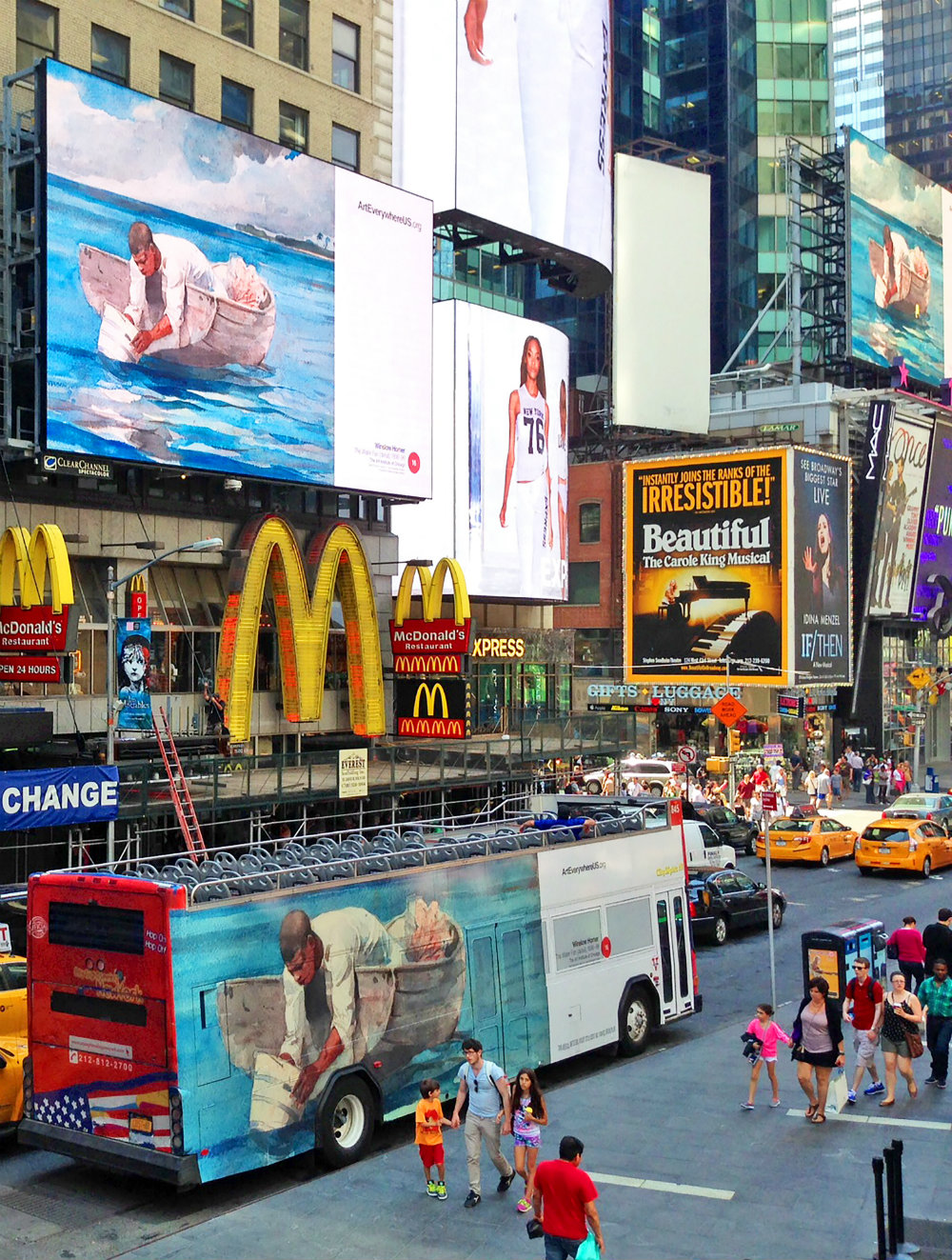
Winslow Homer’s “The Water Fan” displayed on an electronic billboard in Times Square as part of Art Everywhere U.S. (Art Everywhere)
I found the NASDAQ sign at Broadway at 43rd. After waiting out some commercials, George Washington’s grim mug finally showed up—for no more than seven seconds—and then became “American Gothic.” All around, ads for travel, electronics, clothing brands, and even investment companies flashed in rapid technicolor succession.
Jason Andrle services the signs all around Times Square for Signs and Electric and spends most of his workdays walking around the area. Because the Art Everywhere campaign had been up for a few days, I figured he must be familiar with it.
He wasn’t, he said, so I asked him to wait with me for the paintings to show up again. When they did, he suddenly remembered that he had seen them before. Clearly the first time didn’t make an impression. He suggested that the tourists, who spend a lot of time staring at billboards, would probably have a better clue than he.
So I accosted a tourist who was filming pedestrians and signage. The top edge of his viewfinder grazed the bottom of the billboard just as the art came up. He seemed puzzled when I tried to explain Art Everywhere.
I watched a man with a Nikon slung over his shoulder, seemingly waiting for something. His eyes were glued to a group of LED billboards, including the one where George Washington appears. After several minutes I approached him. He was visiting from Hong Kong, he said, and had been standing there 10 minutes. Did he notice? “Not really.”
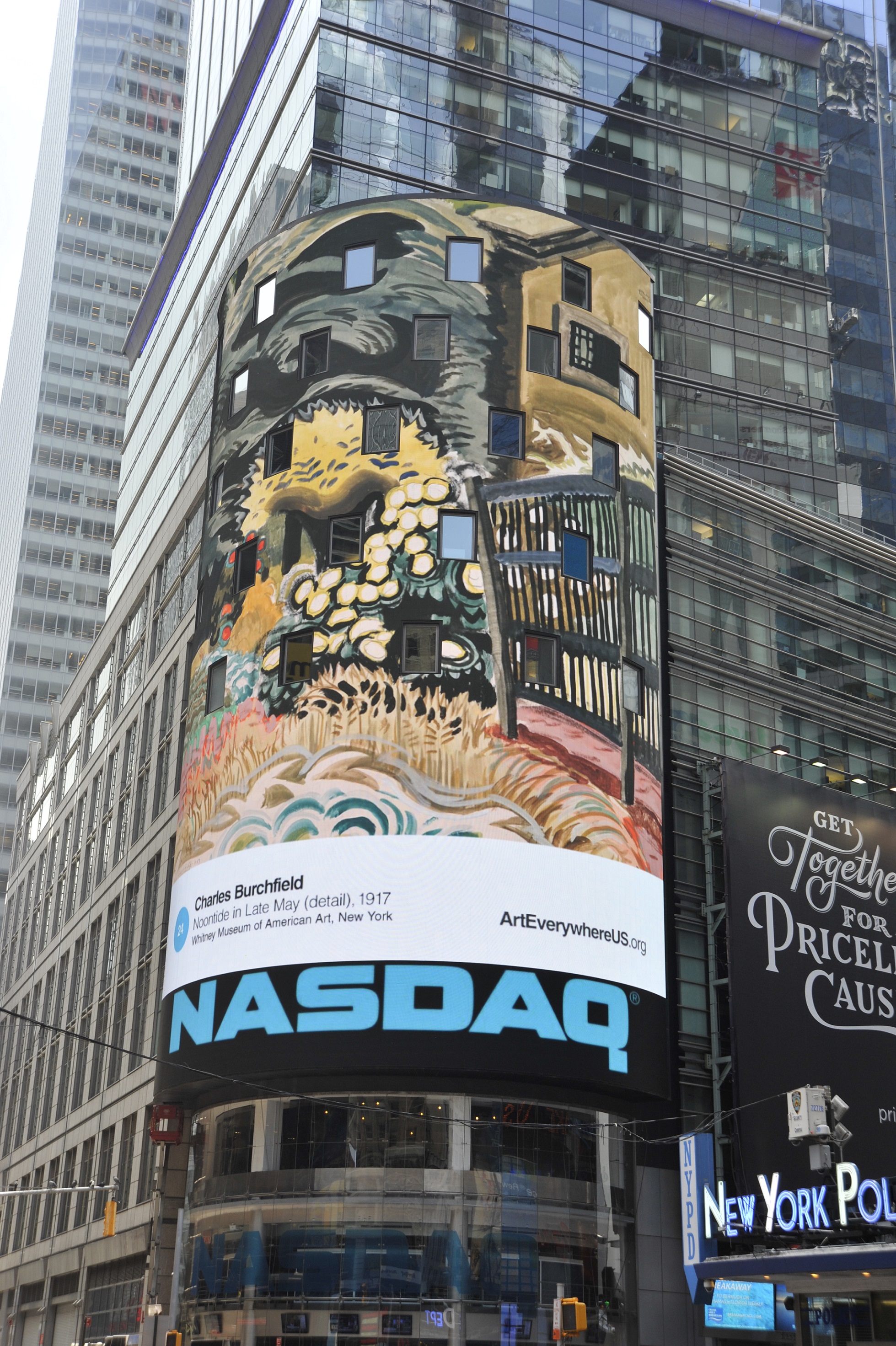
Art Everywhere U.S. Times Square installation, featuring Charles Burchfield’s “Noontide in Late May.” (Robert Landau/Art Everywhere)
Get Thee to a Gallery
Up at the red TKTS steps on 46th Street, Margaret from Guatemala and her family were taking in the atmosphere. Broadway shows and lingerie stores beckoned from every lighted rectangle. The party had been there for five minutes and weren’t struck by any paintings, Margaret told me. I asked if she planned to visit any museums while she’s in town.
“I plan to visit the Natural History Museum,” she said. I clarified that I meant art museums—like the Met.
“Oh. There aren’t that many art museums back home. But I would like to see the great masters someday,” she said.
Finally I lit upon a woman sitting off to the side. Right across from her, Chuck Close’s portrait of Philip Glass glowered from on high before disappearing into a commercial. She was enjoying breakfast out of a paper bag, enveloped in an air of zen only a New Yorker could have.
I plopped down next to her and complained that no one I had spoken to took any note of what organizers called a “very, very big art show.”
“People probably don’t notice because everything here is amusement. That’s what they come here for,” she said. “They’re not looking for art.”
I asked her whether she thought billboards made a good art-viewing experience.
“Billboards are better at advertising shows and entertainment,” she said. “Museums are still the best place to see art. If you see something you like, you might look up the artist and buy something. But why not? It increases exposure for the artists.”
She introduced herself as Jubil Khan, an actress living in the city. I told her about the billboard nearby and we craned our necks. Khan seemed to recognize the Philip Glass painting, which resides at the Whitney. She happens to be a regular there because a friend gives lectures at the museum.
To have a personal link to an art museum through community—that’s not something that marketing can accomplish. Even if images of art on electronic displays can get people to think “art” and subsequently “museum,” probably only a few would feel compelled to visit one. You can lead a tourist to the Met, but you can’t make him emotionally invested—in the art or the institution.
Much has been made about opera ads failing to appeal to audiences who aren’t already fans. Ditto for ballet and classical music. The same might apply to the visual arts.
The organizers of Art Everywhere hope to repeat the event each August nationwide while expanding to other countries. Reed said that the Chinese have expressed interest.
It’s certain that the people could use more chances to organically engage with art. So what’s the best way to foster serendipity? Viewers must be held rapt by what they see. They must have time to let their eyes linger.
While the intentions are admirable, perhaps ad-addled Times Square is not the best place for little moments of reflection.
For more information about Art Everywhere’s U.S. campaign, a map of the locations nationwide, and about the 58 chosen artworks, visit arteverywhereus.org or search the hashtag #ArtEverywhereUS