Black Friday Shopping: 7 Online Stores With Black Friday Deals on Lingerie …
November 12, 2014 by admin
Filed under Latest Lingerie News
Comments Off
Although winter clothes rank high among Black Friday discounts, it’s not only outerwear that features markdowns in the clothing department. Shoppers could find a range of deals on underwear, sleepwear and swimsuits during last year’s Black Friday and Cyber Monday sales.
Here’s a look at over half a dozen online stores that offered discounts last season:
Cosabella
Featuring women’s lingerie, bodysuits and beachwear, the luxury brand Cosabella offered shoppers discounts on its products last Black Friday. During the sale, the retailer offered a 15% discount on all orders of at least $150 with the code BLACKFRIDAY15. The sale was followed up by a Cyber Monday promotion during which the entire site was marked down by 25% with the code CYBER25.
Felina Lingerie
Based in Los Angeles, Felina Lingerie offers a range of intimates and sleepwear. Last year on Cyber Monday, the lingerie brand offered shoppers 25% off plus a free Lilly bikini with the purchase of at least $50. The promotion required the coupon code FYINKD and expired the next day.
Figleaves
Figleaves has the whole family covered. With pajamas, robes and underwear, the retailer features items for women, men and children. Savvy shoppers last year got 25% off all full-priced items by using the code CYBER25 on Cyber Monday.
Hanro
Established in 1884, the Swiss-based company Hanro offers lingerie, nightwear and loungewear for women and men. During its Cyber Monday sale last year, hundreds of items featured discounts up to 70%.
Largo Drive
Women’s intimate apparel retailer Largo Drive offers styles for day and night. Its collection includes bras, panties, swimwear, loungewear, activewear, shapewear and more.
During its Cyber Monday sale last year, the online retailer offered a $20 discount on purchases of $100, $50 off on purchases of $200 and $100 of purchases of $300. But keep an eye out for pre-Black Friday sales, when Largo Drive is known to offer up to 20% off its merchandise.
Shoshanna
Shoshanna features swimwear, clothing and jewelry. Its merchandise can be purchased online or at high-end department stores. Last year, the online store offered a six-day sale starting on Thanksgiving and lasting through the following Tuesday. During the promotion, full-priced items were marked down 30% and already-discounted items were 15% off.
TrueCo
Online lingerie boutique TrueCo offers bras, panties and loungewear in a range of styles and colors. The website offers a quiz to identify your bra size without fitting rooms or tape measure and then offers recommended styles based on your results.
Last November, the retailer kicked off a Black Friday sale that began on the shopping holiday and lasted through Cyber Monday. During the promotion, hundreds of select items were 50% off, including brands such as Cosabella, Elle Macpherson, Honeydew and Samantha Chang. Shoppers who made their purchases on Cyber Monday received the free gift of a three-pack of panties using the promotional codes CYBERSM, CYBERMD or CYBERLG, depending on their size.
For more deals on lingerie and swimwear, keep an eye on Victoria’s Secret, which is known to feature a Black Friday promotion every year.
Written by Melinda Szell
Lingerie image via Shutterstock
Share and Enjoy

Lingerie Maker Sees Revival as Aussie Lifts Manufacturers
November 12, 2014 by admin
Filed under Latest Lingerie News
Comments Off
Gabrielle Adamidis worked three jobs
just three years ago to keep her nascent lingerie-making
business afloat as the Aussie dollar scaled record heights. Now
she’s riding the currency’s slide to stronger sales.
“I feel like I’ve endured the toughest time a business
could go through,” said Adamidis, 32, who founded Hopeless
Lingerie in Melbourne in 2008. “Now, as the Aussie dollar’s
gone down my business has picked up. It’s made a big difference
given my customers are mainly American.”
The Aussie’s 8 percent drop in the past two months is
aiding industries from bra makers to surf-board builders and
helped machinery and transport equipment exports rise 6 percent
last quarter from a year earlier. The country’s manufacturing
industry, which makes up just 6 percent of gross domestic
product, is reviving after being scorched by a currency whose
victims included the 90-year-old domestic car industry.
Tom Folino-Gallo, owner of steel supplier and cement maker
WGE Group, located two hours south of Sydney, said the weaker
currency offered a reprieve to companies that had been “on
life-support” for the past few years.
“My dream is that it goes to 78 cents; at that level we
could sell everything we made,” Unanderra-based Folino-Gallo
said, adding he has cut headcount to 60 from 250 five years ago.
“But another few cents might be enough to do the trick.”
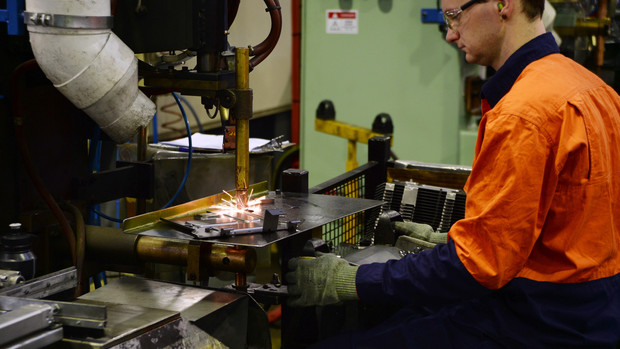
Australia’s manufacturing industry, which makes up just 6 percent of gross domestic product, is reviving after being scorched by a currency whose victims included the 90-year-old domestic car industry. Close
Australia’s manufacturing industry, which makes up just 6 percent of gross domestic… Read More
Open
Photographer: Carla Gottgens/Bloomberg
Australia’s manufacturing industry, which makes up just 6 percent of gross domestic product, is reviving after being scorched by a currency whose victims included the 90-year-old domestic car industry.
Aussie Surge
The Aussie averaged 93 U.S. cents in the past seven years
and touched a record high of more than $1.10 in 2011. That
compares with an average 68 U.S. cents in the previous seven
years that included a record low of 47.8 cents in 2001. It was
quoted at 86.25 U.S. cents at 5 p.m. in Sydney yesterday.
The currency’s surge was fueled by record terms of trade,
or export prices relative to import prices, developed-world high
interest rates, and resource companies pouring billions into new
mines and energy fields.
Some industries didn’t make it out the other side.
In February, Toyota Motor Corp. said it would stop
production in Australia in 2017, joining Ford Motor Co. and
General Motors Co. that announced last year they were pulling
out. Australia’s three car manufacturers haven’t announced any
plans to delay or reverse their decisions in response to the
weaker currency.
“We’re continuing with our plans to stop in 2017,” said
Beck Angel, a Melbourne-based spokeswoman for Toyota. “The
dollar was one of a range of factors” behind the decision to
shut local car plants, she said. Kate Lonsdale, a spokeswoman
for GM’s Adelaide-based Holden unit, and Wes Sherwood, a
Melbourne-based spokesman for Ford’s local division, didn’t
immediately respond to messages left on their mobile phones.
120,000 Jobs
In the 12 months through August, manufacturing employment
has stabilized, rising 0.7 percent. That compares to the loss of
more than 120,000 jobs in Australia in the previous five years
to August 2013, representing about 12 percent of the industrial
workforce, government data show.
“What we’re seeing anecdotally is that the import
replacement story kicks in fairly quickly,” said Julie Toth,
chief economist at Australian Industry Group, referring to
consumers turning to local products as the weaker currency
pushes up import prices. The food and beverage industry, for
example, “seems to be responding quite quickly to movements in
the dollar,” she said.
That’s been the case for some of the nation’s surfboard
manufacturers too, according to Michelle Blauw, co-owner of
Currumbin, Queensland-based D’Arcy Surfboards.
At the currency’s peak, Blauw’s company lost export markets
to Europe and struggled domestically as cheap Chinese boards
swamped Australia. In response, she had to dismiss the company’s
eight staff, sell its premises and work from home.
Growth Again
“Things are changing and the market is improving and
potentially our export markets could increase in the next couple
of years,” she said, adding the company has its own premises
again. “We’re definitely looking toward the future for growth
again. We’re not cowering in a corner like we were.”
Optimism among the small producers could spark the “animal
spirits” that Reserve Bank of Australia Governor Glenn Stevens
is seeking to ignite the economy. The central bank cut rates to
a record-low 2.5 percent in August 2013 to spur hiring and
offset some of the currency’s impact.
Stevens and his colleagues have said the Aussie dollar is
still overvalued in light of weakening commodity markets. Prices
of Australia’s raw material exports have dived this year, led by
about a 44 percent plunge in iron ore. The RBA has indicated it
expects the currency to fall further than the 18 percent seen
since April 2013, which would further help manufacturers.
New Ideas
“A significant re-benchmarking is under way” on the
currency, said Michael Blythe, chief economist in Sydney at
Commonwealth Bank of Australia, the nation’s biggest lender.
“Business has moved from the expectation of an Aussie stuck at
90 U.S. cents or higher to one where a currency somewhere in the
eighties is seen as more likely.”
Morgan Stanley’s strategists project the currency will drop
to 76 U.S. cents by the end of next year. That compares with the
median forecast in a Bloomberg survey of strategists for 85
cents in 2015.
Yet a lower dollar also means local businesses could
generate greater profits, potentially spurring more competition.
“There is a new crop of companies starting now, and when
they start, they don’t start with the highest possible salaries,
they start on the back of a pick-up truck,” said WGE’s Folino-Gallo, 64, who has been in business since 1969. “It’s not just
a question of taking the dust covers off the machinery now the
dollar is down. Either old people get new ideas, or new people
will come to the market to provide them.”
To contact the reporter on this story:
Michael Heath in Sydney at
mheath1@bloomberg.net
To contact the editors responsible for this story:
Stephanie Phang at
sphang@bloomberg.net
Iain McDonald, Khalid Qayum