Censor Board snips sleazy shows on TV
August 2, 2014 by admin
Filed under Lingerie Events
Comments Off
Vague moral policing rules small screen censorship in India. For instance, lifestyle channel FTV had its transmission barred for 10 days following an order dated March 28 last year, for showing what was considered “obscene and women-denigrating content” on innerwear fashion shows.

Last year, NDTV Good Times’ popular show ‘Life’s A Beach’ was hauled on the same grounds for certain episodes telecast in April and May 2011. The show features a female anchor mostly dressed in swimwear exploring beaches all over the world. The action taken constituted an advisory issued to the channel on April 2.

While a one-day ban was imposed upon Manoranjan TV for telecasting A-certificate film ‘Ek Chatur Nar’ in May 2013, the channel got away with a warning for telecasting several films without showing the censor certification in December the same year. Details such as these came to the fore in the reply given to a query in Parliament which pertained to content telecast in Indian homes over the past three years and the current year.

The broad outline that seems to define television censorship is thus: any show that has a woman in lingerie or swimwear is normally considered obscene and can lead to a channel being banned for one to 10 days. The vaguely-coined “obscene and women-denigrating” seems to form a blanket definition for all sexual content that may feature the female body ranging from sensuous to sleazy.

It was the catchphrase cited in an order in January 2014, to take the cinema channel WB off air for one day after it telecasted the rom-com ‘It’s a Boy Girl Thing’.In contrast, action taken on sexually suggestive advertisements seems less strict. Telecasting a certain shower gel commercial over the past year drew a mere warning for IBN 7, MTV, VH1 and Colors. Channels are mostly just warned for showing violence.
Malayalam channel Amrita TV received a warning for telecasting the A-certified film ‘The Don’ in March. The film was certified as adults-only on release owing to extreme violence.
For more news from India Today, follow us on Twitter @indiatoday and on Facebook at facebook.com/IndiaToday
For news and videos in Hindi, go to AajTak.in. ताज़ातरीन ख़बरों और वीडियो के लिए आजतक.इन पर आएं.
<!–
var zflag_nid=”821″; var zflag_cid=”2165″; var zflag_sid=”2″; var zflag_width=”1″; var zflag_height=”1″; var zflag_sz=”84″;
–>


Share and Enjoy

Highlighting Apparel Production and Fashion in Colombia
August 2, 2014 by admin
Filed under Lingerie Events
Comments Off
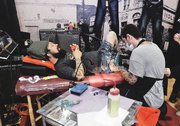
GRAPHIC DESIGN: Tattoos were being given at the Lee Cooper booth at Colombiamoda.

COLORFUL GEAR: Los Angeles handbags company Nicole Lee USA was showing for the first time at Colombiamoda. The line is designed by Suzy Han, left. The company president is Samuel Lee, right.

COLOMBIAN SWIMWEAR: Maria Mercedes from Onda de Mar, which has a store on Robertson Boulevard in Los Angeles, shows off one of the more popular swimsuit styles for the U.S. market.
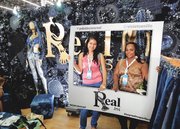
REAL FUN: Colombian company Real Denim had fun with visitors by photographing them in a cardboard frame.
MEDELLÍN, Colombia—Colombiamoda, the country’s largest fashion fair, held every July at the Plaza Mayor exhibition center, had a certain disco vibe during its most recent July 22–24 edition. Everywhere you went in the six gigantic pavilions packed with booths, lively music blasted from speakers.
Models in tight jeans and curvy outfits enticed buyers to booths. With lingerie being Colombia’s second-largest export—after denim pants—an entire pavilion was devoted to the sector. It was filled with shirtless male models showing off their six-pack abs and female models displaying body shapers that did exactly what they were advertised to do. You almost expected Colombian actress Sofia Vergara to make an appearance.
Even though the sexy actress from ABC’s “Modern Family” was nowhere to be seen, there was a booth selling distribution rights and franchises for the Vergara label, which includes clothing, shoes, handbags, sunglasses and accessories.
Colombia is a powerhouse of apparel production in South America, right after Brazil. And the country is fighting to keep its apparel and textile industry vibrant. Every year, Colombiamoda gets bigger with more pavilions and elements to it. This year there were 29 fashion shows, highlighting the styles of Colombian designers as well as a few international designers, such as Spaniard Custo Dalmau, the force behind the Custo Barcelona label.
For the second time in its history, the apparel show incorporated a mass fashion market known as Moda para el Mundo, a relatively new show that had been competing with Colombiamoda.
With free-trade agreements in effect with a number of countries, Colombiamoda subsidized travel for some 631 international buyers.
In total, there were more than 61,000 visitors to the three-day show, with 7,024 national buyers attending as well as 1,552 international buyers. Some 132 buyers came from the United States from companies such as Bebe Stores Inc., Lily Pulitzer, Under Armour and Zumba Fitness.
One first-time buyer was Abdul Danishwar, whose design studio is in the heart of the Los Angeles Fashion District. His 2-year-old company, 3D-Moda Inc., is developing three labels: a menswear line called Alan Dane, a womenswear line called Sitara and a childrenswear label called HanfulKids.
Currently, he is producing shapewear and yoga wear in Peru, where he has attended PerúModa, the annual Peruvian fashion fair in Lima. He thought he would check out Colombia for sourcing possibilities, but he was disappointed. “The prices are elevated,” he said. “They are almost equivalent to what I could get in Los Angeles. I went to a factory where the export price of blue jeans I was quoted was $35 without the cost of shipping.”
However, he did come away with the exclusive distribution rights for a line of sportswear made with UV-protection fabric. The clothing—which includes surfwear, skatewear and childrenswear—is made by SOP Biker.
“Product with UV protection is in demand, but there isn’t enough supply of it in Los Angeles,” Danishwar maintained. “Sourcing becomes simple because this is not a time-sensitive product, and everything is done in Colombia. Wholesale prices for the finished product are about $17.”
Many international buyers were sourcing for lingerie produced at the country’s numerous lingerie factories. Paloma Jonas and Whitney Brown, who recently started up an online lingerie line called Valentine NYC, started sourcing their first products in Medellín after they met a lace house they fell in love with. This was their first trip to Colombia in search of more lingerie factories. “We are very picky, and we like to be in control of the product,” said Brown, who is based in New York and works as a fashion model, as does Jonas.
Jonas recently moved from New York to Los Angeles after becoming engaged to “General Hospital” actor Jason Thompson, who has been in the soap opera for several years. Jonas takes care of the production side of the new lingerie line, which caters to smaller-busted women who like feminine lace bras, bralettes and panties that retail for $38 to $52.
The pair tried sourcing in China, but there was a lack of communication and the factories had high minimums of at least 1,000 pieces, as opposed to Colombia, where minimums for lingerie were around 350 to 400 pieces and the cost to produce and ship a lace bra is close to $15.
Tariff walls
Colombia has had a free-trade agreement with the United States since 2012. In 2013, Colombia exported $267.1 million in apparel and textiles to the United States, a nearly 7.5 percent increase over the previous year.
But the South American country still is very involved in producing clothes for the domestic market rather than the export market.
Carlos Eduardo Botero, the president of Inexmoda, which organizes Colombiamoda every July and its textile equivalent, Colombiatex in January, said that for every $8 of clothing produced in the country, only $1 is exported. One-quarter of that export goes to the United States.
In recent years Colombia has been inundated with a wave of undervalued Chinese apparel that was crossing over from neighboring Panama and infiltrating the country. In 2012, apparel imports rose 25 percent to $843.4 million, compared with the previous year.
To combat the cheap apparel and protect its industry, Colombia in March 2013 hiked its tariff rates on apparel, textiles and footwear. The one-year law, which was recently extended for another two years, imposes a double tariff. There is the principal 10 percent tariff, and then there is an additional $5 per kilo (2.2 pounds) tariff on clothing that costs less than $10 a kilo. Footwear is subject to an additional $5-a-pair tariff.
President Juan Manuel Santos, who flew in from the capital city of Bogotá to open the fair, noted that the double-tariff system is working. “We need to eradicate this informal sector,” he said.
Fortunately for the Los Angeles handbag line Nicole Lee USA, the new tariff doesn’t affect purses or accessories. The company had a first-time booth at the fair to publicize its six distributors in Colombia. On hand were Samuel H. Lee, the LA company’s president; Suzy Han, the line’s designer; and Min Lee, the company’s chief operating officer.
Their booth—filled with cute and colorful handbags, backpacks, shoes and accessories geared to teens and young women—was mobbed with people taking pictures of their cleverly designed goods that wholesale for $38 to $45 before a 16 percent tariff. Everything is made in China.
“Latin America is becoming very strong for us,” Min Lee said, noting the company turned to a distribution model two years ago to grow international business. “It’s so rewarding to see the reaction from our customers here. We will be coming back.”