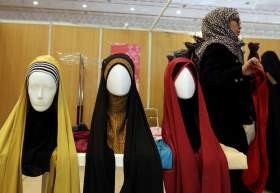
DUBAI, United Arab Emirates — Glitzy billboards in the Middle East and postage stamps in the U.S. Advertisements for lingerie and sales on modest skirts. Lavish buffets and cellphone apps.
Ramadan, Islam’s holiest month, is a boon for retailers in the Middle East, South Asia and beyond. And while some Muslims welcome it as a positive sign, others see it as commercialization of a sacred time of year.
Intended to be a monthlong spiritual cleansing, Ramadan — which ends this weekend — is an exercise in self-restraint that commands Muslims to abstain from food and water from sunrise to sunset.
But for businesses, from California to Cairo, Dubai to Dhaka, Ramadan is also a time to sell.
U.S. fashion house DKNY launched a Ramadan collection aimed at wealthy Arab shoppers. The collection was carried in DKNY outlets throughout the Gulf.
Tamara Al Gabbani, a model and stylist for the collection, said she is glad DKNY took a risk with the modest outfits that include loose skirts and dresses.
“I think it is really, really important the world come together as one and the fact that an American, New York-based brand is coming to us and saying, ‘Hey, we acknowledge this beautiful time of year that you have, and we have made this just for you.’ I love that,” she said.
Al Gabbani also has a clothing line that caters to Gulf Arab women. More than 50 elaborately designed kaftans, which cost up to $550, sold out in the first week of Ramadan.
A Macy’s department store in California welcomed Muslim shoppers with a display at the entrance that said “Happy Ramadan.” The U.S. Postal Service issues special commemorative stamps for Eid al-Fitr, the three-day celebration that marks the end of Ramadan.
Google has gotten in on the action with a special Ramadan portal featuring photos of people around the world breaking their fast at sunset, as well as popular recipes. Several cellphone companies offer Ramadan apps to help people track their prayer and acts of worship.
A marketing study released by the American Muslim Consumer Consortium in conjunction with DinarStandard found that of the 2 billion Muslims worldwide, approximately 9 million are in North America and 60 million are in Europe.
According to AMCC co-founder Sabiha Ansari, Muslim spending power in the U.S. is measured at more than $100 billion. She said she knew of at least one Starbucks in the U.S. that stayed open later during Ramadan for customers fasting during the day.
“We’re hoping it’s the start for other retailers to recognize Muslims as a group that is a strong economic force,” she said. “American Muslims are educated, trendy and economically well-off. They want to integrate the values of their faith with the values of being an American, and this can be a very positive aspect.”
Ramadan is meant to be challenging to the mind, body and spirit. Many Muslims are concerned that Ramadan’s aim to draw worshippers away from indulging in the material world is being eroded.
Many took to Twitter to express their confusion over a lingerie ad in a mall in Durban, South Africa, that featured a model looking seductively at the camera. Only her bra strap and shoulder show, with the rest of her décolletage blacked out under the words “Ramadan Kareem,” or “Happy Ramadan,” written in gold.
The biggest commercialization of Ramadan is concentrated in countries where Muslims are in the majority. The streets of major cities in the Middle East and South Asia are filled with billboards about Ramadan. One McDonald’s ad in Islamabad shows a mosque calling on people to “Dine Divine.”
Carmudi, a website for buying and selling cars, said it is offering a variety of deals for residents of the United Arab Emirates “to celebrate the holy spirit of the season. So dig into your pockets.”
Luxury brand Montblanc urged customers to “celebrate Ramadan in its true spirit with an exciting range of gifts.”
Tehran fashion houses are pushing boundaries in Tehran ATTA KENARE/AFP/Getty Images
In the latest case of Iranian authorities cracking down on fashion they deem “un-Islamic,” a famous clothing design institute called “Khaneh Mode” or Mode House was shut down last week in Tehran. The fashion designer had caused a controversy last month when it held a show with models wearing coats which appeared to be made of the Iranian flag—minus its religious symbols. Nor did it help that the show had allowed men among its audience, which violates conservative Islamic taboos.
This was followed by intense reaction from conservative politicians and religious groups, who cited the show as yet another violation of Islamic mores and traditions, which in turn forced the government to react. “This fashion show did not match the regulations of the Fashion and Clothes Management Workgroup and therefore we have taken legal action,” said Hamid Ghobadi, the workgroup’s secretary according to the official ISNA news agency. “The Khaneh Mode institute has been shut down until further notice.”
The workgroup, which was created by an enactment of parliament, is tasked with organizing Iran’s emerging fashion industry and making it compatible with Islamic standards. It is headed by a deputy minister of Iran’s Ministry of Culture and Islamic Guidance and its members are mostly government officials, with a handful of representatives from the fashion industry. Pictures of the show first emerged on Iranian websites in late June and showed men among the audience—until recently was unheard of in the Islamic Republic. The young female models, who wore white leggings, sported loose coats in the green, white and red tricolor of the Iranian national flag.
Iran’s fledgling fashion industry has begun to evolve in recent years, with shows on the rise. Most of these shows have permissions from the authorities but also underground shows are on the rise which depict more risqué dresses and even lingerie. However, until recently all shows for female clothes were held behind closed doors with no men allowed inside. The audience was also not permitted to take pictures or film.
Following the furor of religious and conservative groups the designers, Khaneh Mode immediately tried to do damage control with a statement on their website apologizing for having inadvertently offended anyone and reaffirming their commitment to “National and Islamic values.” Nonetheless, the authorities acted a few days later and shut them down.
Javid Shirazi, the director of the fashion house, told TIME in Tehran that that “we are completely committed to working within Iran’s native and Islamic framework and we tried to observe these in our show. Inviting men to view shows is permitted since last year so long as the clothes completely cover the body of models and models do not catwalk but walk in a normal and modest manner.”
The shutting down of the fashion house is just the latest instance of an endless tug of war between authorities and women in Iran, one that has been fought since an Islamic dress code was enforced in the aftermath of the 1979 revolution. This clash comes to the forefront every summer, when the latest female attire trends pick up with a tendency towards shorter and skimpier coats and ever tighter legwear, which has been epitomized this year in leggings.
The authorities react every year by escalating their “Morality Patrols.” The outcome is a cat and mouse game between more fashionably dressed women and the authorities. The results can be bizarre—women sporting trendy attire will sometimes take taxis from one side to the other side of squares and junctions just to bypass the morality police.
But over time the will of Iranian women has slowly but surely prevailed, with acceptable dress these days now far beyond the harsh codes of the first years of the revolution, when practically no makeup was tolerated and anything less than a chador—a loose robe that covers the body from head to toe—was frowned upon. And with the election of the more moderate Hassan Rouhani as president last year, many hope that the authorities will relax their strict stance on what women can wear in public.
Officially there has been no relaxation, in fact the authorities have tried everything they could think of to counter it. But in practice it’s a losing battle.
“Since last year there’s been a transformation in the framework of the permits we can get and what we can do,” said Shirazi, who sounded upbeat in spite of the closing of his business. “With the great potential this country has and the great desire young Iranians have, there is a bright future for the fashion industry in Iran, and this [the shutting down of Khaneh Mode] is just necessary experience we need to gain to go ahead.”



















 Newspaper Subscriptions
 eEdition
 RSS
RSS Newsletters