The Best Bra for Your Breast Type
May 15, 2014 by admin
Filed under Choosing Lingerie
Comments Off
Just as the right clothes help you look and feel your best, the right bra could be the missing puzzle piece to perfecting your outfit. That’s why when online lingerie outlet HerRoom released the infographic below—the best bras for your breast type (!)—we were hooked.
Especially because, according to Tomima Edmark, HerRoom’s founder and a bra-fitting expert, women aren’t as great at finding bras that fit their breasts as they are at choosing clothes that fit their bodies.
“The most common mistake women make is buying a bra where the band is too large and the cups are too small,” Tomima says. “My goal was to look at the subtle differences in bras and find out what works for which breasts. You’ll be a better consumer if you know what to look for.”
RELATED: 10 Best Bras for Running
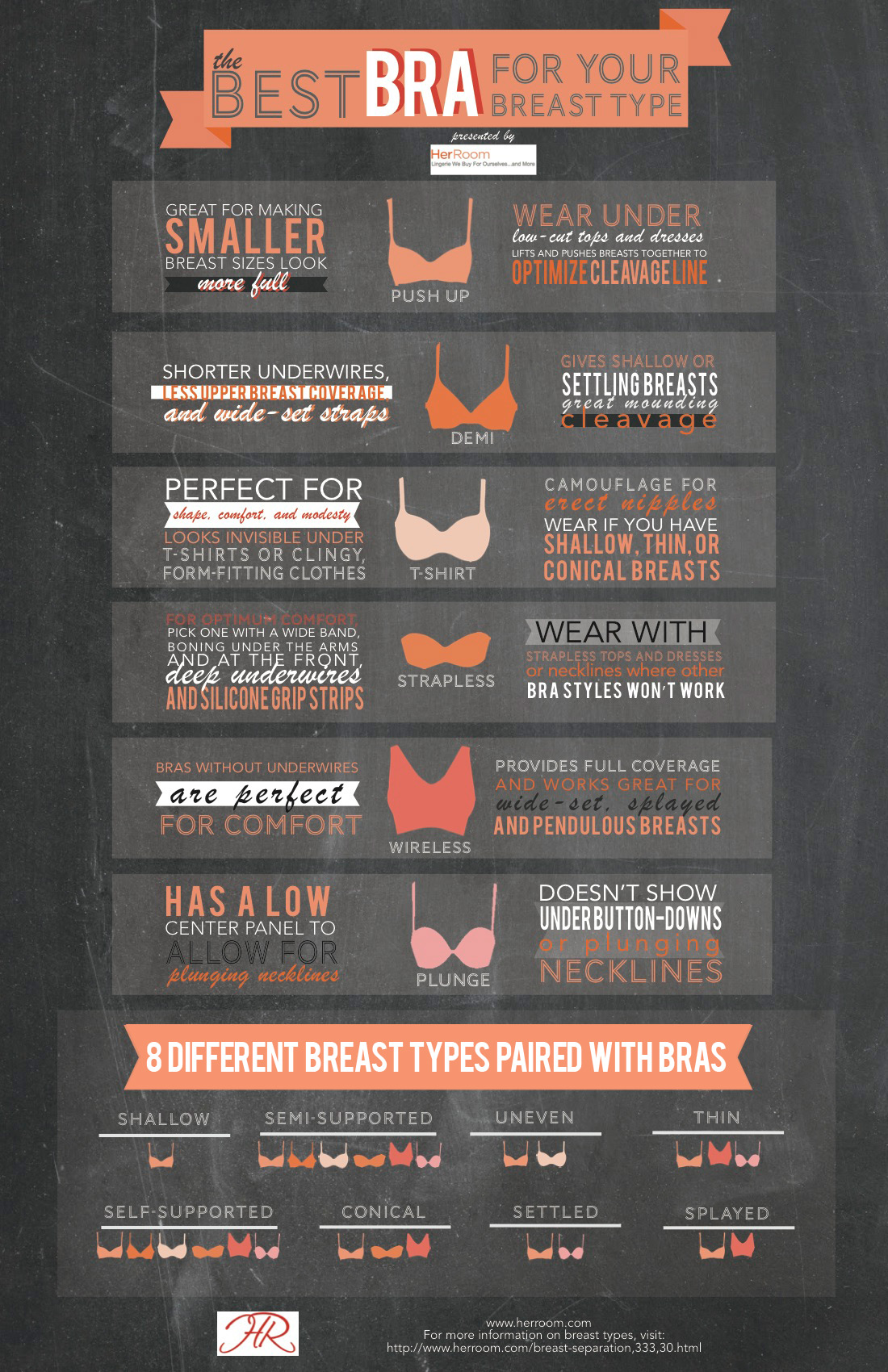
So, here you have the eight different breast types, according to Tomima—and the best bra for each. (Percentages are based on the results of 400,000 women who went through the Know Your Breast Bra Finder.)
1. Shallow: About 10 percent of women. Picture a ski slope: You start at the top and go down to the nipple. You can be born with breasts like this, or they can turn this way after breast-feeding.
The best bra: If you want fullness, you want a push-up with crescent-shaped padding, which will push the lower breast tissue up, bringing your breasts together.
2. Semi-supported: About 30 percent of women. You don’t quite have the fullness of a 16-year-old girl who just got her breasts in, but it’s a nice look.
The best bra: All bras will look great.
3. Self-supported: Sixteen percent of women. This would be a code word for implants. Anyone with augmentation would fall into this category. With or without a bra, breasts are supported.
The best bra: All types—the reason for the bra here is to simply create whatever look you want.
4. Conical: About 6 to 7 percent of women. Generally, a woman who is a C-cup or smaller. The breasts are cone shaped rather than round.
The best bra: Look fuller with padded bras. If you push the apex in, you get more of a natural breast shape.
RELATED: Pretty Intimates: The Season’s Sexiest Lingerie
5. Uneven: Forty-two percent of women. This is when one breast is larger than the other. Most women have uneven breasts simply because if you’re right-handed, that muscle makes the breast on your right side smaller.
The best bra: Always fit your bra to your largest breast. Look for bras that are contour-cupped. A bra cup with a thin layer of foam can act as a nice filler to mold the smallness of your other breast.
6. Settled: Twenty-seven percent of women. This is a nicer way of saying that your breasts are deflated or hanging. You need support and you need to pull those girls up! As you age, breasts are not as firm, but they are malleable, so you can form them into any shape you want.
The best bra: A well-structured, multi-part bra that has cup has seams in it. Seams give your breasts great structure and a nice shape.
7. Thin: About 5 percent of women. If you look in medical journals, this shape is referred to as “tubular breasts.” What that means your breasts are not as wide as the traditional underwire of bras.
The best bra: Bandeau bras. By “smooshing” the breasts together, you make them less “long,” if you will. A contour cup will also work.
8. Splayed: Twenty-seven percent of women. Splayed means your breasts go east-west, so you want to bring ‘em in toward the center.
The best bra: Demi bras will show more of your upper breast. Look at the center panel of a bra and see how the cups are attached. You want to look for a triangular piece in between where the wires meet, and side support panels in the cups will help push breasts center too.
Share and Enjoy

E-commerce edge helps British retailers expand abroad
May 15, 2014 by admin
Filed under Lingerie Events
Comments Off
Thomson Reuters
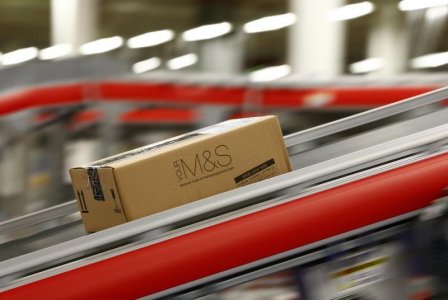
A parcel travels along a belt at the new Marks Spencer e-commerce distribution centre in Castle Donington
By Emma Thomasson and James DaveyBERLIN/PARIS (Reuters) – Marks Spencer Plc is making a new push to expand abroad, hoping e-commerce will give Britain’s biggest clothing retailer a better chance to succeed than earlier attempts to enter new markets.
It is one of several retailers that are using expertise developed in the UK’s fast-growing e-commerce market to expand overseas. Store chains like MS are starting to emulate the success of online-only fashion players like ASOS.
Britain is the world’s most developed online retail market, according to a ranking by commercial real estate firm Cushman Wakefield, followed by the United States, Germany and France.
MS withdrew from mainland Europe in 2001 after a failed expansion. The retreat was temporary. In March the firm said it would use “bricks and clicks” – opening new stores in a few markets while offering online sales in several more – to accelerate growth abroad.
“Because we sit in the UK we sometimes forget how advanced the UK is,” said Laura Wade-Gery, MS e-commerce executive director.
Although the United States is the biggest e-commerce market by absolute turnover, internet orders make up a bigger portion of total retail sales in Britain – about 11 percent in 2013 to 7.3 percent in the United States, Euromonitor data shows.
Britain’s leadership position in e-commerce has been driven by its compact size – which make delivery more cost-effective – along with its relatively high internet penetration.
Retailers are seeking to ship more goods to shoppers abroad, a drive the British government is supporting to diversify exports from a heavy reliance on finance. It launched a plan last year to help 1,000 retailers break into international markets by 2015.
Consultants OCC say UK retailers are beating domestic competition overseas due to wider choice, better prices and fast and reliable delivery. They predict overseas online sales by British retailers will jump to 28 billion pounds ($47 billion)by 2020 from just 4 billion in 2012.
“You can go quite a long way with one warehouse serving the world,” said OCC partner Anita Balchandani. “We should feel pretty confident about the prospects for a nation of shopkeepers with an advantage in the digital world.”
GLOBAL MARKET PLACE
MS is investing 1 billion pounds on logistics, IT and systems. It launched a new web platform in February and is ramping up a new distribution center in central England to fulfill all online orders.
It hopes that will help reverse nearly a decade of market share decline at home and pay dividends abroad as it targets a 25 percent increase in international sales in the next three years and a jump of 40 percent in overseas profits.
After its retreat in 2001, MS started a tentative return to the international stage in 2011 when it opened a store on the Champs Elysee in Paris and launched a French-language website.
The move is part of Dutch Chief Executive Marc Bolland’s strategy to turn the British group into an international “multi-channel” retailer, reaching customers through stores, the web and mobile devices.
Credited with turning around grocer Morrisons, Bolland took over at MS from Stuart Rose in 2010.
MS grew international sales by a third in three years to account for 10 percent of the 10 billion pounds ($16.82 billion) 2013 total and more than 15 percent of operating profit.
Bolland’s “bricks and clicks” mantra involves opening stores in prime locations to publicize the brand, complemented by online sales from local-language websites.
The attempt to meld stores and online presence is best illustrated in Bolland’s birthplace, the Netherlands, where MS launched a Dutch website and “e-boutique” store in Amsterdam last year that allows shoppers to browse the full range of clothes on life-size digital screens and then order online.
There was a 13 percent rise in overseas customers searching for UK apparel retailers online in the first quarter of 2014, according to a British Retail Consortium and Google study, with growth strongest in China, Russia, France and Germany.
Nine local MS websites are already live, with plans to launch in Russia and Finland this year. MS also hopes to add 250 stores abroad by 2017 to the current 455, including new lingerie and beauty boutiques in Saudi Arabia and India.
It already delivers to countries including Australia and Canada from its UK warehouses, a similar strategy to that pursued by Next whose strong online growth has helped it almost catch up with fashion sales at MS.
Next, which sells from 200 stores in 30 markets and delivers to 60 countries from a UK warehouse, saw international online sales grow by 86 percent last year and expects a rise of another 50 percent this year to 150 million pounds.
However, the further afield that retailers stray from Britain, the more they have to plough into local logistics.
ASOS, a darling of the stock market since listing in 2001, saw its shares fall sharply in March when it said investment in warehousing in the UK and Germany, as well as start-up costs in China, would hit annual profit.
Sophie Albizua, co-founder of retail consultancy eNova Partnership, cautions that e-commerce does not mean that expanding abroad has suddenly become risk-free.
She notes that ASOS, which already makes almost two-thirds of sales overseas, is still far more profitable in Britain than abroad if the costs of the head office are taken into account.
“You should be careful with the myth that international expansion online is easier than store expansion,” Albizua said, noting it is costly to create brand awareness online in new markets, especially without the physical presence of stores.
“In practice there are few people who have managed to do that profitably and successfully because the same rules apply as to physical stores.” ($1 = 0.5938 British Pounds)
(Additional reporting by Anthony Deutsch in Amsterdam; editing by Janet McBride)
This article originally appeared at Reuters. Copyright 2014. Follow Reuters on Twitter.