You are here:
Home / Latest Lingerie News
18 hours 15 minutes ago by Dave Fields
No longer can food stamp cards in Louisiana be used in tattoo shops, nail salons, jewelry stores, and lingerie stores, apparently even if the purchase is for edible panties, according to program rules.
On Thursday, Louisiana Department of Children and Family Services (DCFS) implemented an emergency rule to further prohibit the use of Family Independence Temporary Assistance Program (FITAP) and Kinship Care Subsidy Program (KCSP) benefits at certain types of retailers that “provides adult-oriented entertainment in which performers disrobe or perform in an unclothed state for entertainment purposes or adult bookstores or adult paraphernalia and any sexually oriented business,” a DCFS release said.
“We want to ensure that these federal assistance benefits are used appropriately and not at locations that do not help a family meet basic needs,” said DCFS Secretary Suzy Sonnier. “This rule will not affect families who currently use the program as intended, which is to provide food, shelter and clothing for families.”
DCFS noted that Thursday’s enforcement of the new rule is aimed at preventing electronic benefit transfer (EBT) transactions at specific types of stores, vendors and establishments which sell goods or provide services determined to be inconsistent with the purpose of the cash assistance programs and not necessary for basic needs. State Representative Chris Broadwater is working with DCFS to create new legislation to support the rule and allow DCFS to fine retailers who are not following the proper guidelines.
The release said that the DCFS is pursuing “legislation to clarify authorized uses of cash assistance benefits and limits use of benefits at certain types of retailers, including lingerie stores, tattoo shops, and nail salons.”
First-offense violators will have their benefits stopped for 12 months. Second-time offenders lose benefits for 24 months. Third-offense violators lose their benefits permanently.
“FITAP and KCSP provide cash assistance to help pay only for a family’s ongoing basic needs, such as food, shelter and clothing,” DCFS clarified in the release, which included a list of retailers at which EBT cards no longer would be accepted:
Any retail establishment that
Any nail salon
Any tattoo, piercing, or commercial body art facility
Any jewelry store
Any amusement or video arcade
Any bail bonds company
Any nightclub, bar, tavern, or saloon
Any cruise ship
Any psychic business
Any establishment where persons under age 18 are not permitted
“My constituents raised some concerns about where cash benefits are being used,” said Rep. Broadwater. “By working with DCFS to craft necessary legislation, I hope that we can meet the spirit of intent of the program while also ensuring that state and federal tax dollars are being used appropriately.”
In March 2013, DCFS passed a rule which stated that cash benefits can no longer be used in EBT transactions at liquor stores, gaming establishments, or adult entertainment establishments. Benefits could also no longer be used at any store to buy tobacco products, alcohol or lottery tickets.
Recent reports in 2014 have brought more attention to the issue. DCFS provided statistics about FITAP assistance in Thursdays’s release:
“In February 2014, there were 3,479 households receiving FITAP assistance totaling nearly $670,000. In order to receive FITAP, you must be a single or disabled parent with children. The average payment in Louisiana is $192 per month. There were also 2,437 households receiving $1.02 million in KCSP benefits, with an average payment of $419 a month.”
As usual, DCFS relies on retailers and the public to help report suspected fraud, as well as randomly review monthly transactions for possible use at prohibited locations. If a member of the public suspects someone is illegally receiving public assistance benefits or is illegally using an Electronic Benefit Transfer (EBT) card, they should fill out DCFS’ online complaint form at www.dcfs.la.gov/ReportFraud or call 1-888-LAHELP-U and select option 7 from the main menu.
Share and Enjoy
Hers is the face and form that sold thousands of thongs. For seven years, Gisele Bündchen placed her 5-foot-11 frame at the service of Victoria’s Secret, helping fuel demand for the company’s panties and bras. Now the Brazilian supermodel is taking on her former employer and on her own turf.
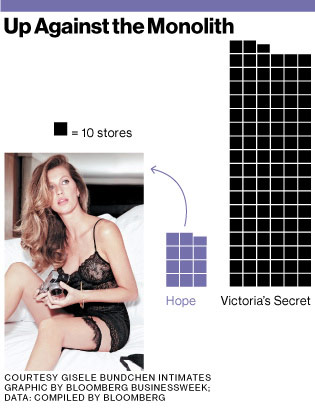 Images of Bündchen sporting her line of lacy underthings are plastered on billboards and buses in major Brazilian cities. Gisele Bündchen Intimates is the product of a three-year-old collaboration with Hope, a Brazilian maker of intimate apparel and swimwear. In May, the family-owned company will inaugurate a Gisele Bündchen Intimates store inside a luxury mall in São Paulo. That happens to be the same month Victoria’s Secret will open a shop inside São Paulo’s Guarulhos International Airport, its first in Brazil.
Victoria’s Secret’s Brazilian debut is emblematic of its corporate parent’s cautious approach. By opening a small outpost in a major international airport, alongside Salvatore Ferragamo (SFER:IM), Tory Burch, and Emporio Armani, L Brands (LB), the Columbus (Ohio)-based parent, is targeting customers who probably already know Victoria’s Secret. Although the $6.7 billion brand has more than 1,000 stores in the U.S., there are just a handful abroad—in Canada, the U.K., and the United Arab Emirates.
“When they enter international markets, they use a test-and-learn model,” says Danielle McCoy, an analyst at Brean Capital in New York, noting that the company usually teams up with a well-established partner and expands only after demand has been proven. L Brands and Dufry, the duty-free concessionaire that will operate the Victoria’s Secret store in São Paulo, declined to comment, as did Bündchen’s twin sister, Patricia, who acts as her spokeswoman in Brazil.
Hope is already a household name in Brazil, where it operates 117 stores, also called Hope. The company is counting on its alliance with the former Victoria’s Secret Angel to catapult it into lingerie’s big leagues, and has plans to open Gisele Bündchen Intimates stores in London, New York, Los Angeles, and other major cities in 2015. “We still have lots of room for growth in Brazil,” says Fabio Figueiredo, Hope’s director of expansion, but “we want to be a global brand.” Hope also plans to increase the number of countries where it sells its wares this year from 18 to 40.
Hope and Bündchen introduced her Intimates line in 2010, offering python-print corsets for 189 reais ($80), hot pink and black lace camisoles for 78 reais, and nude garter belts for 50 reais. Most of the items, like those that carry the Hope label, are manufactured at a company-owned plant in the northeast state of Ceará. Figueiredo says that because Brazilian shoppers expect new styles to be introduced each month, just 5 percent of his inventory is sourced from China. Hope’s own stores generate 35 percent of revenue, a proportion the company intends to nudge higher through the addition of 50 stores this year, all in Brazil. A second Gisele Bündchen Intimates store is also a possibility. Figueiredo declined to provide any financial information, saying only that the company has set a goal of doubling sales within five years.
Hope expects Victoria’s Secret’s entry to step up the competition. Brazilian underwear sales grew 8.2 percent last year, to 13.1 billion reais, outpacing the 7.7 percent increase for all clothing, according to preliminary numbers compiled by Iemi Inteligência de Mercado, a local market-research company. This year lingerie sales should increase by 9 percent, Iemi estimates.
Hope is banking that its Bündchen venture will raise its profile outside Brazil. It’s happened before: Her partnership with Grendene helped the little-known maker of Ipanema-brand flip-flops sell $1.16 billion of sandals last year. That, along with multimillion-dollar ad deals with everyone from Procter Gamble’s (PG) Pantene hair care line to couture designer Chanel, made Bündchen the top-grossing supermodel seven years in a row, according to Forbes. Last year she earned $42 million.
Tying with a celebrity like Bündchen, “if you’re small and unknown, is going to put you on the radar in a way that not many other branding and marketing tactics would,” says Leslie Farnsworth, chief executive officer of FrogDog, a Houston-based marketing strategy consultant.
Share and Enjoy
