ThirdLove Raises $8M To Take On The Lingerie World With A Phone-Based Fitting App
February 3, 2016 by admin
Filed under Latest Lingerie News
Comments Off
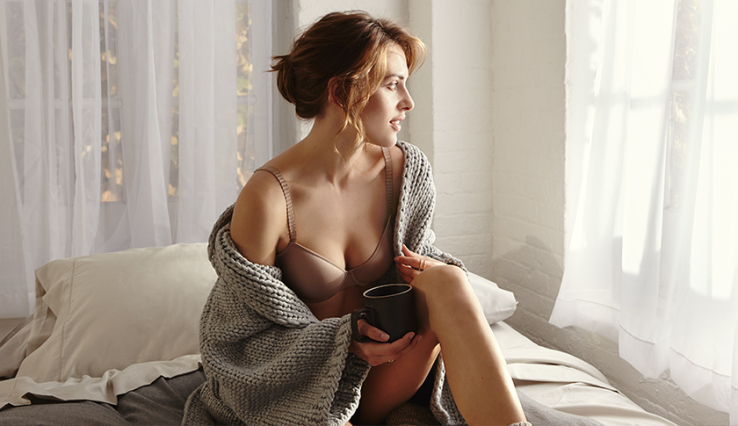
Of the many categories of products that are hard to buy online, one of the most challenging is underwear — and specifically bras. Even at the best of times — when you are physically in a store with a veritable sea of bras at your disposal to try on — the process can be painfully unrewarding, with two bras purportedly made for the same proportions fitting completely differently, and neither very comfortable.
A startup called ThirdLove has been working for years to improve this. Using advanced image recognition technology; a smartphone app; a growing network of bra manufacturers; and experience that the wife-and-husband cofounders Heidi Zak (CEO) and David Spector have gained through previous roles at places like Google and Sequoia, ThirdLove wants to reset the whole process of how to find and buy brassieres. Today, the company got a step up in their its trajectory, with an $8 million Series A round of financing.
The funding is coming from a long list of big names in the VC and fashion retail industries. Led by NEA, the Series A also had participation from Tomorrow Ventures; Felicis Ventures; Laurie Ann Goldman, former CEO of Spanx; Lori Greeley, former CEO of Victoria’s Secret Stores; John Hamlin, Chairman of REI; Barry Sternlicht, founder of Starwood Hotels; Claire Bennett, EVP at American Express and a member of the Board of Directors of Tumi, among others.
It comes on the heels of a $5.6 million Seed round raised in 2013.
On the surface, you might think ThirdLove is your average e-commerce site and app — and there are certainly a lot that are focusing on the lingerie industry.
But not unlike fashion itself, the real story lies beneath the garment. In this case, behind ThirdLove’s storefront is a company working on bringing together cutting edge imaging technologies, big data analytics and logistics and supply management — a classic case of ambitious tech people trying to pool everything they know and know about to solve a hard problem.
ThirdLove rethinks bra making and selling on a few different levels.
The first involves the method it uses to help identify the right size for a customer — through a series of selfies that you take using its app, the app then processes and reassigns these two-dimensional images into three-dimensional shapes and matches them up to its database of own-brand bras.
Importantly, ThirdLove does this measuring on your phone. That is, no selfies are ever uploaded to ThirdLove’s databases or to any other cloud repositories.
But what ThirdLove does do is use the resulting data of sizes to figure out what is really going on in the wider world of consumers who are buying bras. That analysis, in turn, is used by the company to work with bra makers to come up with better models of bras, even going so far as to make more or less of certain sizes based on what its customers are ordering.
This makes the buying process for ThirdLove more efficient. “In the apparel business, you always have to order in advance of demand,” Zak said. “With the data we collect, we’re able to see what sizes and styles are selling better and use that to order better.”
The other place where this makes a difference is in the style of the bras itself. ThirdLove has used its own data to essentially pioneer a whole new range of bra sizes based on half-cup measurements, providing a better set of products to match a wider range of body shapes. “We are the only company that has this data set,” Zak says of the proprietary data.
Essentially, what ThirdLove has done is increase the range of sizes up by 30%, which is a big deal in an industry that’s been stuck essentially between cups A-H (with a big emphasis on A-D in most stores) for a long time.
So far, the proof has been in the pudding, so to speak. ThirdLove says that revenues have grown 400% between 2014 and 2015, with returns of product averaging at only 2%, far below wider industry figures for online returns, which can get up to as high as 30% in some apparel categories.
The company is not revealing any specifics about valuation and revenue but confirms that up to now it’s had “a lot of inbound” — that is to say, acquisition offers — and also requests to provide back-end technology to other retailer players in the lingerie space. So far, it’s rebuffed companies on both fronts.
“We are not interested in selling,” Zak says, ” and we’re not interested in the B2B model right now. What we do is what makes our product so special.”
The longer-term goal will be to use the same tech to expand into other product categories, most likely first something like swimwear since it is an adjacent business to lingerie in terms of fitting challenges, the complexity of designers and manufacturers putting the actual garments together, and of course fashion tastes.
But for right now, ThirdLove is sticking to knickers. “The intimiate apparel is a $15 billion market in the U.S.,” Spector noted, “And China is $18-20 billion and growing 30% year-on-year. We have a lot to do before expanding to new categories.”
Indeed, the fact that some of the investors in this current round come from the lingerie industry is a testament to ThirdLove doing something right.
Share and Enjoy

The lingerie look for spring/summer 2016 fashion: Camisoles, robes, satin and bra-tops
February 2, 2016 by admin
Filed under Latest Lingerie News
Comments Off
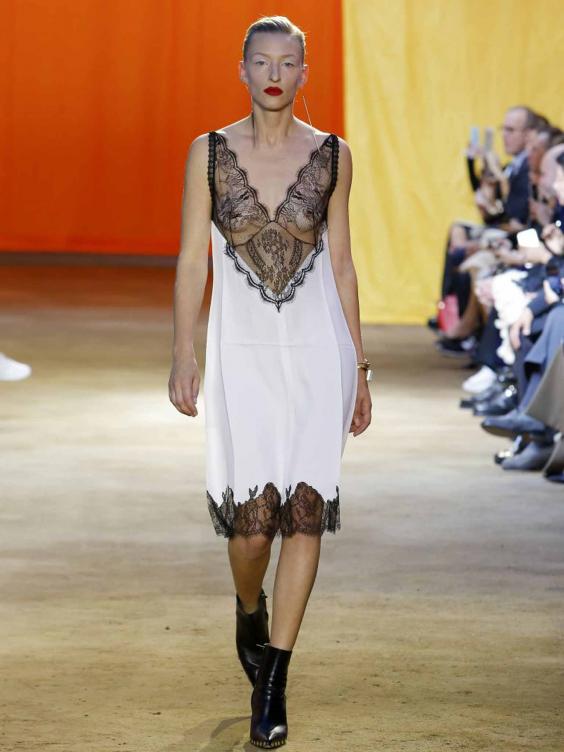
Underwear is outerwear. Please note the slight change in emphasis. Blame climate change; blame heating both underfloor and central, ubiquitously cranked up; blame our ever fluctuating moral compasses, which decree that fashion has had enough of being tastefully covered and is now ready for necklines to plunge and slits to lunge across the body. Regardless of the cause, the ultimate proof came with the spring/summer 2016 shows in September, where models were undressed to impress in clothes that frequently approximated tissue paper knotted up with knicker elastic.
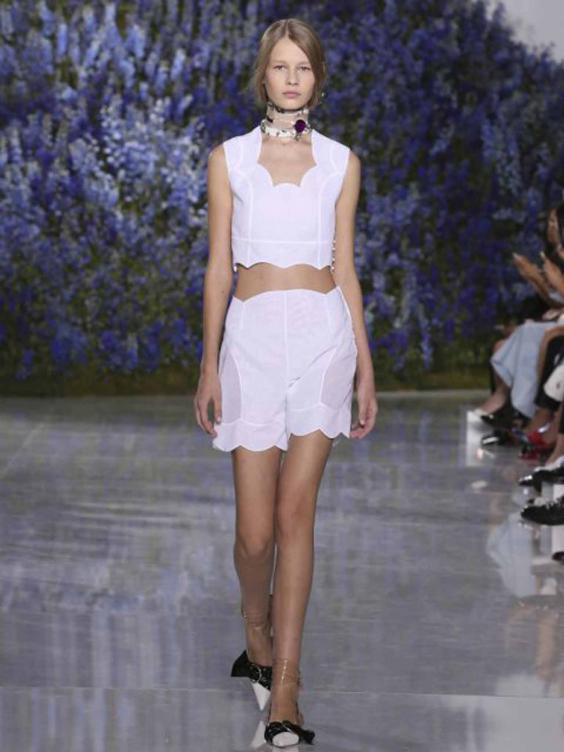
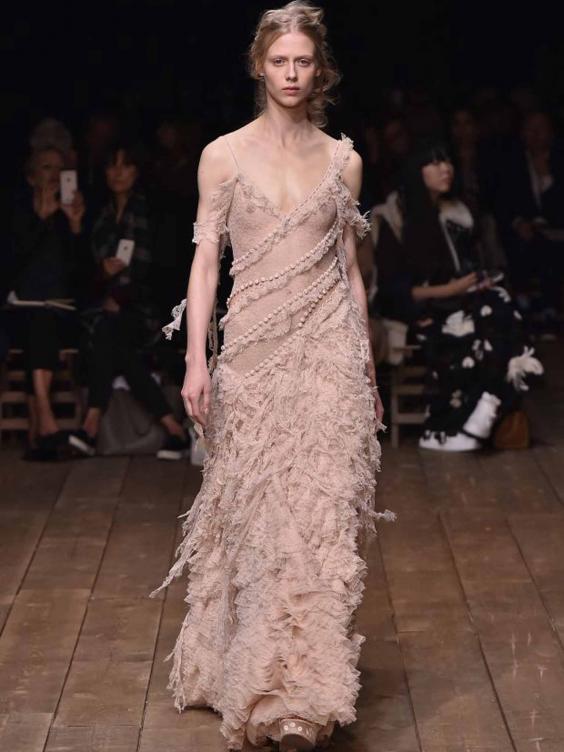
Example: Riccardo Tisci decamped to New York and showed a collection mostly composed of flimsy layered slips in Chantilly lace. Example: Raf Simons ended his tenure at Christian Dior with a show of antique pantalets and bra-tops in semi-transparent cotton, scalloped sweetly at the edges. Example: Sarah Burton delivered her strongest Alexander McQueen collection yet, heaving with ruffles, chiffon and diaphanous layers and fairly devoid of the grand evening dresses with which she’s forged her name and reputation. Elsewhere, designers got to grips with slips, and with stuff like bias cutting (Alexander Wang, Haider Ackermann) and spaghetti straps (Balenciaga to JW Anderson). Generally, it all looked like it should be underpinning an outfit, rather than underpinning an aesthetic.
The mood of aesthetic licentiousness has even encouraged lingerie labels to break out of the knicker drawer. The Italian label La Perla, founded by corset-maker Ada Masotti in 1954, has just appointed 25-year-old wunderkind designer Pedro Lourenço as its creative director. “La Perla… will blur the boundaries between lingerie, beachwear and outerwear,” says the company’s chairman Silvio Scaglia, “extending its natural focus on sensuality, elegance and preciousness.” Those sound like mighty big ideas for smalls. The price tags aren’t exactly diminutive either: a La Perla Maison robe (a glorified dressing-gown) retails for £1,254. I’d want to wear that further than the front door.
La Perla has been here before – it showed collections helmed by the Italian designer Alessandro Dell’Acqua. But relaunching with a focus on lingerie-tinged everyday attire is especially astute given the slant of spring’s shows. Riccardo Tisci didn’t just show slips, but layered camisole tops and lightweight silk tailoring with soft tie-waisted jackets like robes. And Alexander Wang’s final Balenciaga collection, loosely based on ladies lounging in a fashionable spa, injected a sense of undress into everything from filmy silk dresses with flat, lace-embroidered slippers (good) to satin backpacks and combat trousers with a hint of the Shaznay Lewis to them (not so good).
There’s plenty of background for this look. The phrase “underwear as outerwear” was coined in the 1980s by the late Malcolm McLaren, a pithy description of a 1950s-style bullet brassiere worn on the outside of a sweatshirt in the winter 1982 collection he created alongside Vivienne Westwood under the label “World’s End”. It caused an explosion in the fashion scene, inciting Jean Paul Gaultier to design corset-dresses and conical bras.
By the end of the decade, Madonna was sporting the aforementioned poking through suits on her Blonde Ambition tour, and Westwood had set up on her own, reviving an 18th-century “divorce” corset as an elastic-sided bustier. The notion was explored notably by the designer Azzedine Alaïa, who created clothes so technically ingenious that they not only resembled underwear and did its job, but negated the wearing of underclothes. The age of Lycra had dawned, and Alaïa was the king of cling. Many of today’s designers are referencing the work of the aforementioned: JW Anderson’s exterior bras felt very Gaultier; there was a touch of Westwood to Miuccia Prada’s layered baby-dolls over shirts and pencil skirts at Miu Miu. And, by God, everyone copies Alaïa.
But there is actually a foundation (no pun) much earlier: in the clothes of the 1930s, when Madeleine Vionnet’s bias cut dominated. Clothes were streamlined, cut to minimise or even eradicate underwear and show off the natural form of the body. Many were lighter and less complex in their structure than undergarments of 20 years before – or, indeed, 20 years after, thanks to the corsets and petticoats necessary to support Christian Dior’s New Look, the dominant silhouette of the 1950s. Vionnet’s work caused a revolution in women’s clothing, revealing the unfettered form of the body. Nevertheless, despite the underwear antecedents, Vionent’s bias-cut gowns – quickly seized on by Hollywood as the ultimate in silver-screen-siren attire – exuded elegance. They were spectacularly revived by John Galliano in the 1990s, prompting none less than American Vogue’s Anna Wintour to remark: “The bias-cut slip-dress has really become a symbol of what women wore at night in the 1990s – and that was John, completely John.”
Many designers are referencing Galliano today, as opposed to Vionnet’s finest. It’s 1990s grunge, rather than 1930s glamour, that underscored satin dresses with puckered underwear details that Alexander Wang showed for his own label; and the satin slips with ribbon ties by Francisco Costa for Calvin Klein Collection, beaten up and worn with trainers to give underwear an edge. It’s styles like this that make these clothes feel modern, fresh and desirable – and not like you’re a sleepwalker gone a-wandering in your nightclothes.
And, worst comes to worst, if you make a bad investment you can always chuck your autumn/winter wares on top. Outerwear underwear functions well as just plain underwear, too.
- More about:
- Alexander Wang
- Vivienne Westwood
- Malcolm McLaren
- Jean Paul Gaultier
- John Galliano
- Alexander McQueen
- La Perla
- Christian Dior
- Madonna